
Warning chimes sound during a highway merge, then the Kia K5 GT suddenly loses drive. A faulty transmission oil pump can cut power to the wheels, while a separate defect can swell the fuel tank against hot exhaust parts. That fuel-tank defect alone triggered a recall covering 250,547 K5s from 2021–2024.
The 2021–2022 models warrant close recall checks, especially GTs without documented transmission repairs. But recall records alone don’t prove that these are the least reliable K5 years, and newer years aren’t automatically safe bets. Some 2023–2024 cars share the fuel-tank risk, while later models face separate safety recalls.
This guide sorts the risky years, explains the failures behind them, and shows which repairs can change the buying decision.
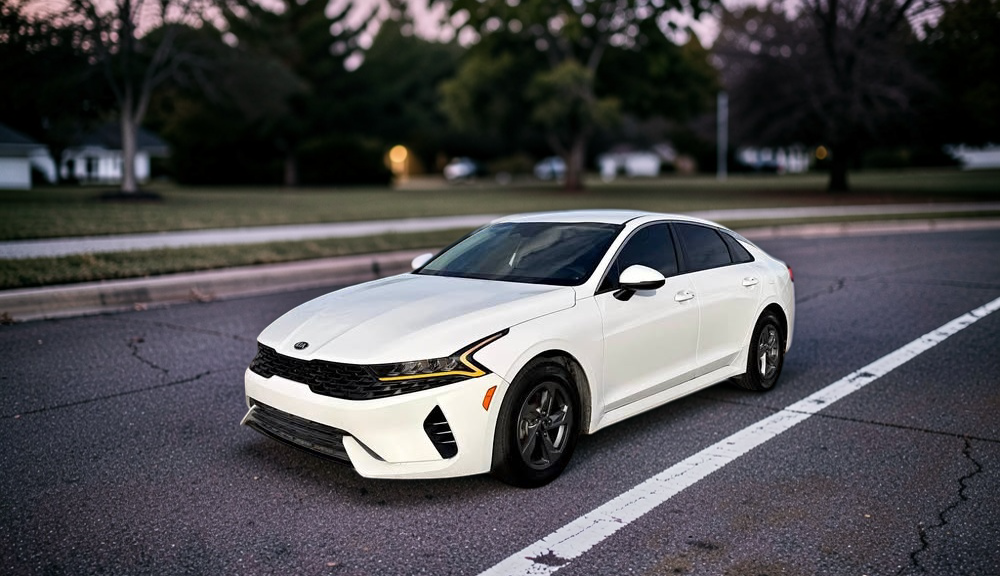
1. Start With the Year, Then Check the Engine
The 2021–2022 K5 Needs Several Recall Checks
The first 2 K5 model years appear in more distinct U.S. recall campaigns than the later years covered here. Both face fuel-system and airbag recalls, while certain GTs can lose drive from a faulty transmission oil pump. Certain 2021–2022 GTs also have separate steering and fuel-pipe recalls. More recall campaigns do not, by themselves, establish a higher overall failure rate.
The trouble doesn’t end with 2022. Kia’s 25V794 / SC356 fuel-tank recall covers 1.6-liter K5s through 2024. Some early 2023 GTs also fall under transmission recall 22V760 / SC250.
| Model year | Buying checks | Main documented concerns |
|---|---|---|
| 2021 | Check engine, VIN, and repair history | Certain GT transmission, fuel-pipe, and steering recalls; curtain-airbag and small-batch occupant-classification recalls; 1.6-liter fuel-tank recall |
| 2022 | Check engine, VIN, and repair history | Certain GT transmission, fuel-pipe, and steering recalls; curtain-airbag recall; 1.6-liter fuel-tank recall |
| 2023 | Check the build date and completed campaigns | Certain early GT transmissions, curtain airbags, C-pillar trim, and the 1.6-liter fuel-tank recall |
| 2024 | Check fuel-tank and trim recall status | Outside SC250’s model-year scope, but affected 1.6-liter cars remain within SC356; C-pillar trim recall also applies to certain cars |
| 2025 | Check lighting and trim recall status | New standard engine is outside SC356’s 1.6-liter scope; certain cars have parking-light and C-pillar trim recalls |
| 2026 | Check instrument-display recall status | Certain cars have an instrument-cluster software recall; long-term reliability remains unproven |
GT-Line Looks Sporty, but GT Has a Different Gearbox
A GT-Line badge can fool buyers into expecting the GT’s mechanical faults. The 2021–2024 GT-Line uses a 180-hp, 1.6-liter turbo engine with 195 lb-ft of torque. It sends power through a conventional 8-speed automatic.
The actual GT packs a 290-hp, 2.5-liter turbo engine with 311 lb-ft. It uses an 8-speed wet dual-clutch transmission, or DCT. Certain 2021–2023 GTs are covered by recall SC250 for an electric oil-pump defect in that transmission.
All-wheel drive doesn’t change this distinction. A GT-Line AWD still uses the conventional automatic, while the GT comes with front-wheel drive. The transmission recall applies to affected GTs, not GT-Line models.
The 2025 Engine Change Removes a Major Fuel-Tank Risk
Kia dropped the 1.6-liter turbo from standard K5 models for 2025. Its replacement is a naturally aspirated 2.5-liter four-cylinder producing 191 hp and 181.5 lb-ft in Kia’s detailed specifications. Kia kept the conventional 8-speed automatic.
The new engine gains 11 hp but loses 13.5 lb-ft of peak torque compared with the older 1.6-liter turbo. Peak output figures alone don’t establish how the engines will feel in everyday driving. The GT retains its 290-hp turbo engine and wet dual-clutch gearbox.
This change removes the standard 2025 K5 from the 1.6-liter engine population covered by SC356. It avoids that specific fuel-tank defect, not every possible fuel-system problem. The engine change also says little about long-term durability because these newer cars have fewer years of service behind them.
For 2025–2026 non-GT buyers, the naturally aspirated 2.5-liter engine and conventional automatic are mechanically distinct from the GT’s turbocharged engine and wet DCT. The conventional automatic is outside the GT-specific SC250 transmission recall, but that alone doesn’t establish superior long-term reliability.
2. A Failed Check Valve Can Push the Fuel Tank Into the Exhaust
The Fuel-Tank Defect Reaches Through 2024
A plastic fuel tank can swell until it presses against the hot exhaust. That danger led Kia to recall 250,547 K5 sedans under 25V794 / SC356. The recall covers affected 2021–2024 models with the 1.6-liter turbo engine, built from March 27, 2020, through January 23, 2024.
The trouble starts with the purge control system check valve in the evaporative-emissions system. When that valve deteriorates, pressurized air can flow from the intake manifold into the fuel tank instead of in the intended direction.
Pressure can build inside the plastic tank, causing it to expand into contact with hot exhaust-pipe components. Continued driving in this condition can cause localized melting, possibly allowing gasoline to leak and increasing fire risk.
Owners may notice popping sounds near the fuel-tank area, a check-engine light, or rough running. Fuel odor or visible leakage can indicate a more serious problem. If either occurs, stop the engine, do not drive the car, park outside, and arrange towing to a Kia dealer.
The Recall Repair Goes Beyond a Software Update
Kia’s SC356 repair targets the check valve and any damage already done to the tank. Dealers install an improved purge control system check valve and inspect the fuel tank for damage, replacing it if necessary. They also ensure the engine-control software has the required update.
A tank that remains intact doesn’t automatically need replacement. But swelling, heat damage, or melting can require a new fuel tank. Clearing the check-engine light alone won’t repair warped plastic or restore safe exhaust clearance.
The recall repair is free for affected vehicles. Still, the repair order matters when buying a used K5. It should identify the valve replacement, tank inspection results, and any tank replacement performed.
An Older Emissions Repair Record Can Leave a Dangerous Gap
Some K5s already received work under Kia’s earlier emissions campaign, SC288, or its later SC288A update. Those actions could include engine-control software work and inspections, with replacement of the fuel tank and/or purge-system check valve when necessary. The exact repair depended on what technicians found.
The campaigns have separate records. An invoice showing SC288 or SC288A completion doesn’t prove the newer SC356 safety recall was performed. Kia says vehicles that received similar work under SC288 still need to complete SC356.
Kia’s SC356 recall filing also states that the defect wasn’t corrected during production of the affected vehicles. That rules out assuming late-built 2024 cars received a factory fix.
For any 2021–2024 K5 with the 1.6-liter turbo, verify SC356 completion against the 17-digit VIN. If the tank shows swelling or heat damage, a valve-only repair leaves the damaged tank in place.
3. A Faulty Oil Pump Can Leave the K5 GT Without Drive
The Transmission Recall Also Catches Early 2023 GTs
Certain 2021–2023 K5 GTs have a transmission defect that can cause loss of drive after warning lights, a dashboard message, and audible chimes appear. Kia recall 22V760 / SC250 covers 3,426 K5 GTs from those model years. Affected cars were built between November 16, 2020, and August 12, 2022.
The fault starts inside the 8-speed wet dual-clutch transmission’s electric oil pump. Poor soldering can allow a part to detach from the pump’s circuit board. That electrical failure can disrupt the hydraulic pressure needed to operate the transmission’s clutches.
Drivers may hear warning chimes and see a check-engine light. The dashboard can also display “Stop Safely Immediately.” Kia documented a 20–30-second period of normal driving before the transmission disengages its drive gears.
That short window shouldn’t be treated as enough time to reach a highway exit. Losing drive during a merge or in a busy intersection raises the risk of a crash. If the warnings appear, stop at a safe location, turn off the engine, and arrange towing for repair.
One Fault Code Can Mean a Complete Transmission Replacement
Kia’s SC250 repair procedure centers on diagnostic trouble code P1C2D03. This code points to the high-pressure electric oil pump’s motor-position sensor. Technicians use Kia’s diagnostic equipment to check whether the transmission control unit has stored it.
If P1C2D03 isn’t stored, the prescribed recall repair is a transmission-control software update. The revised software changes how the gearbox responds to the pump fault. A completed recall under this repair path doesn’t mean the transmission was replaced.
A stored P1C2D03 changes the repair. Kia instructs technicians to replace the complete dual-clutch transmission assembly and install the applicable software. The dealer must also perform hydraulic air bleeding and transmission learning before confirming normal operation.
The repair order should show which path the dealer followed. A software update and a complete DCT replacement are different repairs, even though both can close recall SC250.
The August 2022 Factory Fix Draws a Clear Line
Kia introduced a corrected electric oil-pump circuit board and revised transmission software on August 13, 2022. That production change separates later-built 2023 GTs from the recalled population.
The change addresses the specific soldering defect behind SC250. It doesn’t guarantee that every later DCT will remain trouble-free. Clutch wear, hydraulic faults, and other transmission problems still need separate diagnosis.
A brief hesitation during low-speed clutch engagement doesn’t automatically prove oil-pump failure. Repeated loss of drive, harsh engagement, or transmission warnings deserve closer inspection. Fault codes and actual shift behavior matter more than the GT badge alone.
For an early GT, check the production date and SC250 repair history. A stored P1C2D03 under the recall procedure calls for transmission replacement, not merely another software update.
4. Early K5 GTs Face Separate Fuel and Steering Recalls
A Faulty Fuel-Pipe Connection Can Leak Gasoline
Some 2021–2022 K5 GTs have a fuel-leak risk under recall 21V519 / SC214. The affected K5s were built from November 16, 2020, through May 12, 2021. The high-pressure pipe connects the fuel pump to the fuel rail. Some connections weren’t tightened correctly, while a limited supplier lot contained pipes manufactured out of specification.
Fuel can escape at the pipe connections, raising the risk of fire. Warning signs can include fuel odor, visible leakage, smoke, a burning or melting odor, and a malfunction indicator light. Any detected fuel smell or leakage calls for immediate action.
Kia’s SC214 repair first checks the pipe’s lot/date code. An affected-lot pipe is replaced and tightened to specification. Other pipes are checked for leakage, replaced if leaking, or checked and tightened to specification if no leak is found. The recall applies to certain 2.5-liter turbo K5s, not every K5 engine.
Kia instructs affected owners to shut off the engine if they notice fuel odor or leakage. Arrange towing rather than restart the car to check whether the smell returns.
A Steering Software Fault Can Make the Wheel Harder to Turn
Certain early K5 GTs can develop unexpected steering resistance during assisted driving. Recall 21V447 / SC213 covers affected 2021–2022 GTs built from November 16, 2020, through May 12, 2021.
The defect is in the control logic for the Rack-Mounted Motor Driven Power Steering system, or R-MDPS. If a communication fault occurs while Lane Following Assist is engaged around a curve, the steering system may retain its pre-fault assistance level instead of responding correctly after the curve.
Once the car exits the bend, the steering wheel may require more effort than expected. The sudden increase in steering effort raises the risk of a crash.
Kia addresses the defect by updating the electric power steering software. The published recall procedure doesn’t call for steering-rack replacement or wheel alignment. Until the repair is completed, Kia advises affected owners not to activate Lane Following Assist.
A completed transmission software update doesn’t clear this separate steering campaign. For an affected VIN, verify SC213 completion through a Kia dealer and retain the repair record.
5. Airbag Defects Can Stay Hidden Until a Crash
Nearly 189,000 K5s Have a Curtain-Airbag Installation Recall
An improperly installed side curtain airbag may fail to deploy correctly during a crash. Kia recall 23V149 / SC263 covers 188,912 K5 sedans from the 2021–2023 model years.
The fault starts with improper installation at Kia’s Georgia assembly plant. Affected cars were built from March 27, 2020, through December 9, 2022. Only certain vehicles built after November 16, 2022, fall within the final recall window.
An incorrectly installed curtain airbag may fail to unfold as intended during a collision. That leaves occupants at greater risk of injury, especially during a side impact. Kia identified no advance warning for this defect.
Dealers inspect both curtain-airbag installations and reinstall any incorrectly installed units as needed. The repair is free, and SC263 doesn’t call for routine replacement of the airbag module. A clear dashboard and normal test drive can’t confirm proper installation.
A Small 2021 Batch Can Fail to Disable the Passenger Airbag
Another airbag recall affects just 124 K5 sedans from the 2021 model year. Recall 21V164 / SC207 covers cars built between February 3 and March 4, 2021.
The defect involves the passenger-seat Occupant Classification System (OCS). Its control unit was calibrated incorrectly during production. As a result, it may fail to recognize a child restraint placed in the front passenger seat.
The front passenger airbag could remain active when it should be suppressed. In a crash, deployment could seriously injure a child. The “PASSENGER AIRBAG OFF” indicator may also remain unlit.
Kia’s repair replaces the faulty OCS unit with a properly calibrated part. Technicians must then initialize/reset the new unit using Kia’s diagnostic equipment. The replacement and initialization are performed free under SC207.
Kia warns against placing child restraints in the front passenger seat, including after the repair. For an affected 2021 K5, verify SC207 completion and retain documentation of the OCS replacement and initialization.
6. Newer K5s Have Trim and Dashboard Faults of Their Own
Loose Rear Window Trim Can Detach While Driving
Some 2023–2025 K5s have exterior trim that can detach while driving. Kia recall 25V493 / SC346 covers 100,063 vehicles built from October 3, 2022, through July 24, 2024.
The fault involves the C-pillar garnish beside the rear window. Insufficient adhesive application can allow its outer faceplate to progressively separate from the base. If the car continues to be driven in that condition, the faceplate may eventually fall off.
Owners may notice a visibly loose faceplate, rattling, or wind noise near the rear window. A detached piece can create a road hazard for other road users and increase crash risk.
Kia’s remedy replaces affected C-pillar garnish assemblies not previously replaced under warranty with improved assemblies, free of charge. The improved design adds mechanical retention alongside the adhesive. Model-year 2025 K5s built from July 25, 2024, received the revised design during production.
The 2025 Parking Lights Can Flicker Because of Bad Software
Kia recall 25V351 / SC341 covers 82,281 K5 sedans from the 2025 model year. Affected cars were built between February 20, 2024, and April 23, 2025.
The problem sits inside the Power-net Domain Controller, which manages certain lighting functions. When a turn signal operates while the headlamps are steadily illuminated or the parking lamps are activated, incorrect software can cause the corresponding parking lamp not to remain steadily lit.
This violates the conspicuity requirements of Federal Motor Vehicle Safety Standard 108. Reduced visibility to other drivers increases the risk of a crash.
Kia corrects the fault with updated controller software. Dealers can install the update, while eligible cars can receive it over the air. Both repair paths are free.
The recall doesn’t cover 2026 K5s. For an affected 2025 model, confirm SC341 completion rather than assuming the software updated itself.
A 2026 K5 Can Lose Its Entire Instrument Display
A blank instrument screen creates a different problem for certain 2026 K5 owners. Recall 26V046 / SC361 covers 1,327 K5 sedans built from July 3 through September 24, 2025.
Electrical signal noise can trigger the instrument cluster’s overheat protection when no actual overheating has occurred. The display then goes blank, hiding the speedometer, warning indicators, and tire-pressure alerts.
The fault doesn’t necessarily stop the engine or disable the equipment being monitored. But the driver loses access to critical information while the car remains in motion.
Kia’s repair updates the instrument cluster software to reduce signal noise and prevent false overheat protection. Dealers can perform the update, or eligible vehicles can receive it over the air. The recall doesn’t require routine replacement of the instrument panel.
Kia introduced corrected software into K5 production on September 25, 2025. Cars built before that date need a VIN check to establish whether SC361 applies and whether the update was completed.
7. Crash-Test Weaknesses Limit the Appeal of Newer K5s
A Good Front Crash Score Doesn’t Tell the Whole Story
The Kia K5 earns a Good rating in the IIHS small-overlap front crash test. That rating applies to 2021–2026 models. But tougher tests reveal weaker protection for rear passengers and occupants in side crashes.
IIHS updated the moderate-overlap front test to measure rear-seat protection and made the side-impact test more severe using a striking rig representing a modern SUV. The K5 performed poorly in some of those areas. Older Good ratings used different test methods, so they don’t prove that earlier K5s offer better protection.
| IIHS crash test | Rating | Applicable K5 years |
|---|---|---|
| Small-overlap front | Good | 2021–2026 |
| Updated moderate-overlap front | Poor | 2023–2026 |
| Updated side impact | Marginal | 2021–2026 |
Rear Passengers Face the Biggest Frontal Crash Concern
The updated moderate-overlap front test exposed a weakness in rear-seat protection. IIHS gave the 2023 K5 a Poor overall rating, which also applies to 2024–2026 models.
The driver received Good injury ratings across the measured body regions. The rear passenger dummy showed a different result. Head and neck injury measures earned a Poor rating, while chest protection rated Marginal.
The updated side-impact test raised separate concerns. IIHS used a 4,200-pound barrier traveling at 37 mph to simulate a collision with a heavier vehicle. The K5 earned Marginal ratings for its structure and driver torso protection.
During that test, the driver’s head moved below the side curtain airbag and struck the door’s window sill. IIHS rated driver head protection Acceptable, below its highest rating. Rear passenger pelvic injury measures also rated Marginal.
These results are separate from the curtain-airbag installation defect covered by 23V149 / SC263. Completing that recall corrects the affected installation, but it doesn’t change the published crash-test results.
The 2025–2026 K5 retains a Poor updated moderate-overlap frontal rating and a Marginal updated side-impact rating.
8. An Early K5’s Remaining Warranty Matters to the Buying Decision
A Completed Recall Doesn’t Guarantee Future Transmission Repairs
Kia performs eligible safety-recall repairs free of charge, regardless of the car’s remaining factory warranty. That includes the fuel-tank, airbag, steering, and transmission recalls covered earlier.
But recall completion has limits. Under SC250, Kia replaces the GT’s dual-clutch transmission only when the required inspection supports that repair. Cars without stored P1C2D03 receive updated transmission-control software instead.
Kia’s service bulletin states that later transmission concerns follow normal service and warranty rules. A GT that received the software update isn’t automatically entitled to a free gearbox years later.
For a used GT, the repair invoice should show whether technicians updated the software or replaced the DCT. Repeated clutch shudder, loss of drive, or stored transmission codes need a written diagnosis. Don’t price the car as repaired when the cause remains unknown.
Kia’s 10-Year Warranty May Not Transfer to You
Kia advertises a 10-year/100,000-mile powertrain warranty, but that coverage has ownership restrictions. It applies to the original purchaser and qualifying Kia Certified Pre-Owned buyers. An ordinary used-car purchase doesn’t automatically carry the same protection.
The standard 5-year/60,000-mile basic warranty covers eligible factory defects, and its remaining coverage transfers with the vehicle. Both time and mileage limits run from the original in-service date. Coverage ends when either limit is reached. Wear, maintenance, and other exclusions still apply.
That date can catch buyers off guard. A 2021 K5 first placed in service during 2020 could have exhausted its basic warranty during 2025. Low mileage won’t extend the 5-year limit.
Certified Pre-Owned coverage can provide longer powertrain protection, but that powertrain term still runs from the original in-service date and zero miles. A car certified several years after its first sale doesn’t receive a fresh 10-year term. Separate CPO comprehensive coverage has its own term and conditions.
Before buying, have a Kia dealer verify the VIN, in-service date, mileage, and remaining warranty coverage. An early GT with unexplained transmission faults needs a written repair estimate before any deposit changes hands.
Sources & References
- NHTSA Part 573 Safety Recall Report 25V794 / Kia SC356
- Kia SC356 dealer notification / NHTSA-hosted recall notice
- Kia SC288 voluntary emissions service campaign Q&A
- Kia SC288A owner notification
- NHTSA Part 573 Safety Recall Report 22V760 / Kia SC250
- Kia SC250 Rev. 2 remedy instructions / service bulletin
- Kia/NHTSA owner notification for 22V760
- NHTSA Part 573 Safety Recall Report 21V519 / Kia SC214
- Kia SC214 dealer recall notice
- Kia K5 owner notification for 21V519
- NHTSA Part 573 Safety Recall Report 21V447 / Kia SC213
- Kia SC213 MDPS Operation Logic Improvement bulletin
- NHTSA Part 573 Safety Recall Report 23V149 / Kia SC263
- Kia SC263 Side Curtain Airbag Inspection/Reinstallation Bulletin
- NHTSA Part 573 Safety Recall Report 21V164 / Kia SC207
- Kia SC207 dealer notification
- Reproduced Kia SC207 bulletin – KDS reset and child-restraint warning
- NHTSA Part 573 Safety Recall Report 25V493 / Kia SC346
- NHTSA Part 573 Safety Recall Report 25V351 / Kia SC341
- Kia OTA Software Update Release Notes
- NHTSA Part 573 Safety Recall Report 26V046 / Kia SC361
- Kia Important Safety Recall notice for 26V046
- 2021 Kia K5 specifications
- 2024 Kia K5 specifications
- 2025 Kia K5 specifications
- 2026 Kia K5 specifications
- New 2025 Kia K5 Makes North American Debut at Chicago Auto Show
- 2026 Kia K5 – IIHS
- IIHS Side Test
- IIHS Moderate Overlap Front Test
- Kia U.S. Warranty
- Kia Certified Pre-Owned Benefits