
The test drive is smooth, and the dash shows no warning lights. But an affected 2024 Grand Highlander can still have an open curtain-airbag recall. In certain crashes, the curtain may not unroll as intended when the corresponding front window is lowered, reducing its protection.
Run the VIN through NHTSA’s recall search. If it shows open recall 24V-461, I’d pass until Toyota replaces both curtain airbags. Completed recalls don’t appear in that search, so a clear result alone won’t tell you whether this SUV needed the repair. If the seller says Toyota fixed it, ask for the dealer’s repair order showing both sides were replaced.
A documented repair puts the 2024 back on my list. With price, mileage, and condition close, I’d start with a 2025. This guide shows what could change that choice, from a click while accelerating through a turn in certain 2024 models to a steering recall on certain 2026 builds.
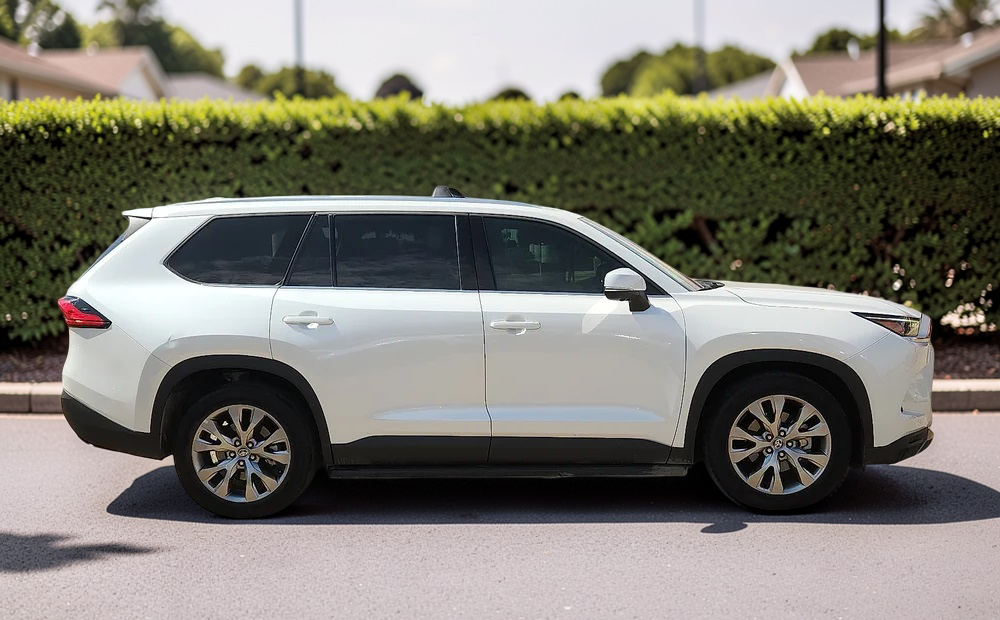
1. Which Grand Highlander years deserve the most caution?
Toyota’s first U.S. Grand Highlander was a 2024. A used listing for a 2023 Highlander points to a different SUV, with its own repair history.
When the repair record changes the deal
| Model year | Buying call as of November 4, 2026 | What matters on that SUV |
|---|---|---|
| 2024 | Pass while an applicable safety recall is open. | For recall 24V-461, look for a dealer record showing both curtain airbags were replaced. The defect does not have a warning that identifies it. |
| 2025 | A reasonable place to start if price, mileage, and condition are close. | The 2024 curtain-airbag recall does not cover 2025 models. Check the VIN for other applicable recalls, including the instrument-cluster recall 25V-595 and rear-camera recall 25V-744. Equipment and VIN determine coverage. |
| 2026 | Hold off if a steering-knuckle or rear-axle-carrier recall is open. | Certain VINs require inspection under recalls 26V-598 or 26V-437. Toyota replaces an affected part; if inspection finds no part from the affected batch, replacement is not required. Check the VIN for the applicable Toyota campaign. |
| 2027 | Too early to judge long-term reliability. | Toyota announced the 2027 model on October 1, 2026, and said dealership arrivals were expected later in the year. There is not yet meaningful long-term experience history to assess. |
The 2025 recommendation is a shopping preference, not a reliability assessment. A repaired 2024 may be a sound choice, and any used Grand Highlander should be checked by VIN for applicable open recalls.
When a repaired 2024 makes the better buy
A safety recall identifies a safety-related defect and the vehicles covered by the recall. A service bulletin gives technicians guidance for diagnosing or repairing a condition. An owner complaint records what a driver reported, but the report alone cannot identify which part failed or confirm a defect.
A 2024 has had longer to accumulate mileage than a 2026. Comparing complaint counts alone does not establish which model year has a higher failure rate. That comparison would require confirmed failures and a comparable measure of the vehicles in service and their mileage.
At the same price, I’d consider a 2024 with records showing both new curtain airbags over a lower-mileage 2026 awaiting a steering inspection. The repair order documents what was replaced. On the 2026, the dealer inspection determines whether the knuckles need replacing. NHTSA complaints are owner reports, not confirmed failures, so raw complaint totals should not be treated as failure rates.
2. Why the 2024 Grand Highlander needed new curtain airbags
The curtain may not unfold as intended beside an open window
In certain crashes, the curtain airbag drops from the roof rail to cover the side window. On affected 2024 Grand Highlanders, a curtain may not unroll as intended when the corresponding front window is lowered. This can leave less restraint and increase the risk of injury. Toyota’s initial U.S. notice advised drivers to keep the driver-side window closed until repair. Because the amended recall also covers the passenger-side curtain, keeping both front windows closed until both curtains are replaced is a prudent precaution.
Toyota’s June 2024 recall initially covered the driver-side curtain. On August 6, Toyota added the passenger-side curtain on those same SUVs. The Grand Highlander campaign covered about 76,700 gas models and 35,000 hybrids built from mid-June 2023 through mid-June 2024. The more exact production window in the recall filing is June 13, 2023, through June 10, 2024. Toyota told dealers not to sell affected new vehicles until the repair was complete. The wider NHTSA recall total also includes Lexus TX vehicles.
What proves both airbags were replaced
Toyota says there is no warning that identifies this curtain-airbag condition. A normal airbag-light check at startup does not establish whether the recall repair was completed. NHTSA’s VIN search shows unrepaired recalls and does not display a recall that has already been repaired. A zero-open-recall result therefore does not prove that a vehicle was never included in recall 24V-461.
Ask a Toyota dealer for the recall history tied to the VIN. For an affected SUV, look for a completed repair order under Toyota campaign 24TA09 that identifies replacement of both the left- and right-hand curtain-shield-airbag assemblies. An entry showing only that parts were ordered is not proof the repair was completed. Toyota’s remedy is free. A publicly posted repair record quotes 3.1 labor hours, but that labor time could not be confirmed in public Toyota or NHTSA remedy material.
3. Why I’d start with a 2025 Grand Highlander
The 2025 avoids the specific 2024 curtain-airbag recall, but it is not automatically free of recalls or defects. Check each vehicle’s VIN and service history before buying.
The gauges can work today and stay dark at the next start
The 2025 is outside Toyota’s curtain-airbag recall. Its dashboard still deserves a closer look. Recall 25V-595 covers certain 2024 and 2025 Grand Highlanders equipped with a 12.3-inch digital combination meter, the screen behind the steering wheel. The size of the center touchscreen does not establish recall coverage.
Faulty software can repeatedly write unnecessary data to the combination meter’s memory. As the memory wears out, the display can stay dark at startup. The driver may lose the speedometer and miss brake or tire-pressure warnings. Even if the gauges light up on a test drive, check whether Toyota completed the applicable software update.
A frozen backup camera can still show a clear driveway
When shifted into Reverse, the rear-view image can freeze or go blank on certain vehicles. A frozen frame may be harder to notice: someone could step behind the SUV while the screen still shows the previously empty space.
Recall 25V-744 covers certain 2024 through 2026 gas and hybrid Grand Highlanders equipped with Toyota’s Panoramic View Monitor. The dealer updates the parking-assist software. If both screen recalls apply to the VIN, look for completion of both campaigns. The camera update does not update the combination-meter software.
The wrong load label can leave you counting on payload you do not have
Recall 24V-548 covers certain 2024 models with Gulf States Toyota accessories and an affected accessory-weight label. That label’s figure may be too high or too low. Recall 26V-179 applies to a very small group: two 2025 gas Grand Highlanders and 21 hybrids across model years 2025 and 2026. On those vehicles, the label understates the reduction in carrying capacity caused by Toyota-installed accessories, which can make the remaining capacity appear greater than it is. Both recalls remedy the problem with a corrected label. Neither campaign identifies a weak spring or axle.
The corrected figure matters when you fill all three rows or hitch up a trailer. Passengers, bags, and trailer tongue weight all draw from the same payload allowance. If the accessories weigh 50 pounds more than the label indicates, there are 50 fewer pounds available for the vehicle’s other load. Use the corrected label for the specific vehicle.
4. Which 2026 builds need a rear axle or steering inspection?
Toyota’s filings tie the rear-axle-carrier recall to an April 2026 production run and the steering-knuckle recall to a June 2026 run. These windows and counts identify potentially involved vehicles, not vehicles confirmed to have a defective part. Check the VIN if the build date falls in either window.
| 2026 recall | Gas Grand Highlander | Grand Highlander Hybrid |
|---|---|---|
| Rear axle carrier, 26V-437 | April 10–27; 1,510 vehicles | April 10–27; 2,449 vehicles |
| Front steering knuckle, 26V-598 | June 19–26; 126 vehicles | June 19–25; 127 vehicles |
Toyota campaign identifiers for the rear-axle recall can differ by vehicle. Check the applicable campaign against the VIN rather than relying on a single campaign number.
Why Toyota checks the rear axle carriers on April builds
Under recall 26V-437, some forged-aluminum rear axle carriers missed the supplier’s ageing-furnace process and may have below-specification strength. A carrier could break where it attaches to the toe-control arm, reducing rear stability and increasing crash risk in some conditions.
The dealer inspects both rear axle carrier subassemblies for specified codes. If neither carrier is from an affected batch, inspection is the remedy and no replacement is required. A carrier identified as affected is replaced free of charge, even if the rear end has not made noise during a test drive.
A June steering knuckle can feel fine until it takes a hard hit
For recall 26V-598, one batch of front steering knuckles missed the ageing-furnace step and may have below-specification strength. A sudden large impact, such as hitting a pothole or curb, could fracture a knuckle at the strut or tie-rod attachment. Steering control could be reduced or lost, increasing crash risk in some conditions.
If the VIN has an open steering recall, have Toyota inspect the knuckles before you buy. Toyota replaces knuckles from the affected batch at no charge. If inspection finds no affected knuckle, replacement is not required. An alignment does not establish which production batch a knuckle came from.
5. What to listen and feel for on a Grand Highlander test drive
A 2024 can click as you pull through a turn
Ease into the gas as you turn out of a parking space. On certain 2024 gas and hybrid Grand Highlanders, a front drive shaft can click repeatedly under that load. Toyota’s bulletin says the noise can occur even without a grease leak.
Toyota bulletin T-SB-0028-26 directs the shop to reproduce the noise and identify whether one or both shafts are the source. The affected shaft or shafts are replaced with updated assemblies. The bulletin states powertrain warranty coverage of 60 months or 60,000 miles from the in-service date, whichever comes first, for the specified condition. Ask the dealer to check the VIN and original in-service date; coverage is not unconditional.
A pause in Reverse tells a different story than a hard shift
Select Reverse, lift your foot off the brake, and note how the SUV responds. If Reverse engages slowly or you feel a thump accelerating from first to second, record whether the symptom repeats when cold, after the vehicle warms up, or under light throttle. Those observations alone do not identify the cause. Ask for a written diagnosis and estimate before buying if the symptom repeats.
The 2.4-liter turbo gas model uses an 8-speed automatic. The 2.4-liter Hybrid MAX uses a 6-speed automatic. The 2.5-liter Hybrid uses an electronically controlled continuously variable transmission, or eCVT, which does not have conventional stepped first and second gears. A low-speed jolt in a hybrid needs diagnosis; symptoms alone do not identify the source.
A cold-start camshaft code can have a software fix
On certain 2024 gas models, an engine-computer programming error can temporarily leave the exhaust camshaft timing lock pin stuck. The check-engine light can come on, and a scan may show P05CE00, a cold-start camshaft timing code.
Toyota’s Special Service Campaign 24TC05 covers about 40,540 Grand Highlanders built from mid-June 2023 to early January 2024. The campaign provides a free engine-computer software update. Check the VIN for eligibility before authorizing camshaft repairs. If the light returns after the update, have the shop read the code again before pricing parts. This is a service campaign, not a safety recall.
A Hybrid MAX can hesitate on the move or shudder at a red light
On certain 2024 Hybrid MAX models, holding the accelerator steady may produce hesitation between 0 and 40 mph. Toyota bulletin T-SB-0017-24 Rev. 1 calls for updated engine-computer software. The bulletin applies to the Hybrid MAX and its 6-speed automatic.
A shudder at a red light points to a different bulletin on certain 2024 and 2025 Hybrid MAX models. Under T-SB-0028-25, Toyota specifies an update to the hybrid control computer. The bulletin describes the shudder with the vehicle stopped in Drive, the brake applied, and hybrid-battery charge above 76%.
6. Why a Grand Highlander may take less fuel than its listed tank capacity at the pump
A 12.5-gallon fill tells only part of the story
Toyota lists a 17.2-gallon tank for the 2024 Grand Highlander Hybrid and a 17.8-gallon tank for the gas model. A 12.5-gallon receipt is 4.7 gallons below the Hybrid’s listed capacity, but that difference is not a measurement of reserve fuel. The receipt alone cannot show how much fuel was in the tank before refueling, why the nozzle stopped, or whether the tank has a fault.
Toyota’s November 2023 tech tip documented reports of difficulty adding more than 12 to 15 gallons to 2024 gas and hybrid models from an empty condition, even when the gauge read full. Toyota asked dealers to record gauge readings and gallons dispensed and to contact Toyota Assistance Services before diagnosing or repairing the condition, except on weekends and holidays. If it happens again, note the gauge reading and gallons dispensed and ask the dealer to follow the tip.
Which hybrids qualify for the low-fuel light update?
Toyota bulletin T-SB-0060-25 covers certain 2024 and 2025 Grand Highlanders with the 2.5-liter Hybrid or Hybrid MAX powertrain. On affected SUVs, the low-fuel warning can come on earlier than expected, reducing the distance driven between fills. The bulletin limits eligibility by production-change VIN for each powertrain and configuration.
The dealer uses Toyota’s diagnostic system to compare the combination-meter calibration ID with the version listed for that engine, meter size, and grade. A short number by itself does not establish whether an update applies. The software update addresses the listed low-fuel warning, refueling-volume, and range complaints. It does not change tank capacity or promise a particular increase in gallons dispensed at the next fill.
For a qualifying occurrence of the condition described in the bulletin, Toyota Basic Warranty coverage is 36 months or 36,000 miles from the vehicle’s in-service date, whichever comes first. On a used hybrid, check both the original in-service date and mileage with Toyota. Coverage is limited to the condition described in the bulletin.
7. Where the Grand Highlander’s crash ratings differ by year
The driver’s head moved toward a gap beside the front airbag
When the 2024 Grand Highlander struck the barrier on its front left corner, the upper dash moved about 4 inches into the cabin. The driver dummy’s head contacted the frontal airbag, then rolled around its left side toward the gap in coverage between the frontal and side-curtain airbags. The dummy still recorded Good injury scores, including for the lower leg and foot. IIHS rated the driver-side small-overlap test Acceptable, including for the structure and the driver’s movement.
The passenger side earned Good in the same type of crash. IIHS applies the small-overlap ratings to 2024 through 2026 models. IIHS publishes an Acceptable driver-side rating based on the 2024 test, but it does not publish a separate crash-test rating for a 2024 vehicle after its curtain airbags are replaced.
The 2025 frontal test put a dummy in the second row
The 2024 earned Good in the original IIHS moderate-overlap front test, which evaluated the driver but did not measure protection for a second-row occupant. The updated test added a second-row dummy. In the 2025 Grand Highlander, that dummy earned Good scores for the head and neck, chest, and thighs. The rear restraints also earned Good for how they controlled the dummy’s movement.
In the updated side-impact test, the 2024 result is Good for the 2024 model, and the 2025 result applies to 2025 and 2026. These are side-test ratings, not an overall safety grade. If your family regularly uses the second row, the distinction is in the frontal test: IIHS applies the updated moderate-overlap rating to 2025 and 2026 and publishes no equivalent second-row frontal score for the 2024.
Sources & References
- Toyota 2024 Grand Highlander introduction
- Toyota 2027 Grand Highlander announcement
- NHTSA amended 2024 curtain-airbag recall report
- Toyota interim curtain-airbag recall notice
- NHTSA VIN recall lookup
- NHTSA instrument-cluster recall report 25V-595
- NHTSA rear-camera recall notice 25V-744
- NHTSA load-label recall report 24V-548
- NHTSA load-label recall report 26V-179
- NHTSA rear axle carrier recall report 26V-437
- NHTSA steering knuckle recall report 26V-598
- Toyota 2026 rear axle and steering recall announcement
- Toyota 2024 Grand Highlander brochure and powertrain specifications
- Toyota front drive-shaft bulletin T-SB-0028-26
- Toyota Special Service Campaign 24TC05 notice
- Toyota 24TC05 engine-computer software instructions
- Toyota Hybrid MAX hesitation bulletin T-SB-0017-24 Rev. 1
- Toyota Hybrid MAX stopped-shudder bulletin T-SB-0028-25
- Toyota refueling tech tip T-TT-0742-23
- Toyota low-fuel warning bulletin T-SB-0060-25
- 2024 Toyota Grand Highlander owner’s manual and fuel-tank capacity
- NHTSA investigations, recalls, and consumer complaints
- NHTSA manufacturer communications and service bulletins
- IIHS 2024 Toyota Grand Highlander ratings
- IIHS 2025 Toyota Grand Highlander ratings
- IIHS 2026 Toyota Grand Highlander ratings
- IIHS original moderate-overlap front test
- IIHS updated moderate-overlap front test