
A metallic knock interrupts the test drive, and the Forte’s low price stops looking tempting. Worn connecting-rod bearings can turn that noise into an engine replacement. Certain 2014–2015 cars with the 2.0-liter GDI engine fall under Kia’s engine-fire recall. The repair depends on what the dealer finds.
Buying newer brings another concern. Certain 2019–2021 Fortes have documented IVT slipping problems that can leave acceleration lagging behind engine speed. Kia’s repair instructions include transmission replacement for specified fault-code cases. A receipt saying “software updated” deserves a closer look.
This guide identifies the Kia Forte years to avoid, stronger alternatives, and the repair records, coverage limits, and theft risks worth checking.
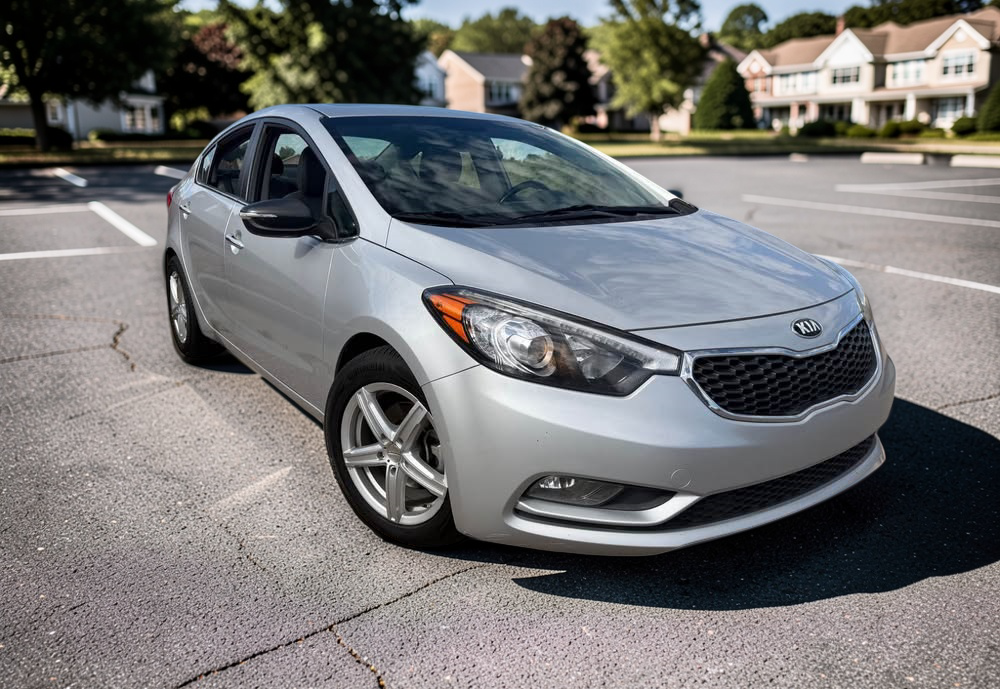
1. The cheapest Forte can carry the biggest repair risk
2014-2015 are the main caution years, especially with engine knock, oil loss, or missing campaign records. This buying judgment weighs documented defects and repair needs. Complaint counts alone can’t tell you what percentage of Fortes will fail.
| Model years | Buying position | What changes the decision |
|---|---|---|
| 2010-2013 | Approach cautiously with missing records. | Certain cars have brake-control electrical-fire and airbag recalls. The 2.4-liter engine also has a separate bearing-damage history. |
| 2014-2015 | Pass on unresolved engine symptoms or undocumented campaign work. | Certain 2.0-liter GDI cars fall under the engine-fire recall. A separate cooling-fan recall affects certain 2014 cars, including 1.8-liter versions. |
| 2016 | Consider only after identifying the engine. | Certain 2.0-liter GDI cars received a bearing-detection software campaign. Assess the 1.8-liter engine separately. |
| 2017-2018 | Match the warning to the engine. | Certain 2.0-liter MPI cars have an oil-pump recall. The 2.0-liter GDI has different bearing-coverage eligibility. |
| 2019-2021 | Give IVT-equipped cars extra scrutiny. | Kia’s TRA102 bulletin lists certain cars across all three years, but campaign and repair eligibility depend on the VIN. Manual and GT dual-clutch versions need separate assessments. |
| 2022-2024 | A stronger starting point with verified service records. | Standard immobilizers improve theft protection. These years fall outside TRA102’s listed Forte production range, but certain 2023 cars need urgent control-arm repairs. |
A newer badge doesn’t prove the fault disappeared
Certain 2016 Forte and Koup models with the 2.0-liter GDI received PI2105. This campaign adds Knock Sensor Detection System software, or KSDS, to detect vibration associated with excessive connecting-rod bearing wear. Installation doesn’t replace the bearings or establish their condition.
The transmission warning also extends beyond the 2019 launch. TRA102’s opening applicability chart lists certain IVT-equipped 2019-2021 Fortes built from July 9, 2018, through October 21, 2021. However, its page-11 “Affected Vehicle Range” table, and the separate SC199 campaign notice, list certain 2019-2020 Fortes built from July 9, 2018, through April 2, 2020. Confirm campaign status and coverage for the specific VIN rather than treating the broader bulletin chart as proof of campaign eligibility. A 2020 model year alone doesn’t prove the transmission concern was resolved.
Recall completion and engine condition are separate checks
Under SC200, dealers inspect for fuel or oil leaks and test the engine. They repair or replace it as required by the findings, so a completed recall doesn’t always mean a replacement. Ask for the repair order showing what the dealer found and repaired.
On certain 2017-2018 MPI cars, particles can jam the oil pump’s relief plunger and reduce oil pressure. Kia’s SC210 instructions address abnormal engine noise, an oil-pressure warning, or a check-engine light. For affected cars showing those symptoms, Kia directs owners to shut off the engine and arrange a tow.
2. The engine under the hood changes the risk
The 2014-2015 recall doesn’t cover every engine
Recall 20V750 / SC200 covers certain 2014-2015 Forte and Forte Koup cars with the Nu 2.0-liter GDI engine. Certain 2012-2013 cars with the Theta II 2.4-liter MPI engine also qualify. The 1.8-liter engine falls outside this campaign’s listed applications. So does a 2.0-liter MPI engine, despite sharing its displacement with the GDI.
GDI injects fuel directly into the cylinders. MPI injects it into the intake ports. Those names identify different engine applications, and Kia assigns campaign eligibility accordingly.
Kia’s campaign documents describe engine-compartment fires without identifying one manufacturing or design defect behind every case. Dealers check for fuel and oil leaks, test the engine, and repair it as required. Engine replacement depends on those findings. The recall doesn’t promise every affected car a new engine.
A 2016 EX needs a different check than an LX
The U.S. 2016 Forte sedan came with a 1.8-liter MPI engine in LX trim. The EX used a 2.0-liter GDI. That difference matters when checking the car’s bearing-damage campaign history.
PI2105 covers certain 2016 Forte and Forte Koup cars with the Nu 2.0-liter GDI engine. Its production range runs from April 13, 2015, through July 18, 2016. The campaign installs KSDS software to detect vibration linked to excessive connecting-rod bearing wear. It doesn’t replace worn bearings.
A full dipstick can hide repeated top-ups
Fresh oil at the full mark tells you the level today. It won’t reveal how much the seller added yesterday. Repeated top-ups and falling dipstick readings need a measured consumption test. A knock that persists after warm-up needs separate diagnosis.
The oil-pressure lamp doesn’t measure how much oil remains in the pan. Oil can fall below the correct level before pressure drops enough to trigger it. Waiting for that lamp leaves you without a reliable record of oil loss.
Kia’s ENG222, revised April 3, 2025, lists 2014-2024 Fortes among its applications. It gives a test and repair path, not a failure rate. It also establishes no universal engine-failure window at 67,000-90,000 miles.
The dealer first repairs confirmed external leaks, records the oil level, and starts a 1,000-mile consumption test. After the first test, the dealer verifies maintenance records. If consumption is more than 1 quart per 1,000 miles, the bulletin directs combustion-chamber cleaning, where applicable, followed by another measured test. If the post-cleaning test remains above that threshold, the bulletin directs engine removal and replacement, subject to approval and warranty-coverage validation. Work outside warranty requires DPSM approval.
Keep the recorded mileage and oil quantities from both tests. A cleaning invoice alone doesn’t show whether consumption improved. ENG222 classifies consumption below 1 quart per 1,000 miles as normal and more than 1 quart per 1,000 miles as excessive.
3. A sticking oil-pump plunger can starve the engine
The recall covers a narrow production window
Recall 21V260 / SC210 affects a potentially involved population of about 4,069 Fortes with the 2.0-liter MPI engine. The affected cars were built from June 5 through July 24, 2017, across the 2017 and 2018 model years. Kia must confirm eligibility by VIN. The 4,069 figure is not a count of confirmed failures.
Inside the oil pump, a relief plunger helps control oil pressure. Particles that escape the filter can catch at a sharp edge and jam the plunger. Oil pressure can then fall, reducing lubrication. Continued driving can damage the engine and cause a stall.
Kia lists abnormal engine noise, an oil-pressure warning, or a check-engine light as possible signs. On an affected car showing these symptoms, shut off the engine and arrange a tow. Kia’s instructions don’t allow continued driving to the dealership.
The repair invoice should show a new oil pan
The recall remedy replaces the oil pan with one containing two magnets. Those magnets capture particles before they can lodge in the pump’s plunger. The dealer also replaces the oil filter. SC210 doesn’t call for replacing every affected car’s oil pump.
An ordinary oil-change receipt won’t document this repair. The dealer record should identify SC210 and the replacement pan and filter. Kia performs the recall repair at no charge to the owner.
The separate piston-ring recall, 21V259 / SC209, covers specified Soul and Seltos models, not the Forte. Its defective-ring findings therefore don’t establish the cause of a Forte’s oil loss. Its Piston-ring Noise Sensing System update, or PNSS, isn’t a Forte recall requirement.
4. The IVT warning extends beyond 2019
A 2020 or 2021 badge doesn’t clear the transmission
Press the accelerator, and engine speed rises while the car struggles to gain speed. Slipping inside the Intelligent Variable Transmission, or IVT, can produce that mismatch. Kia documents delayed acceleration and a check-engine light among the affected cars’ symptoms.
Campaign SC199, previously referred to as SA424 / ELE200, addressed certain 2019-2020 Fortes. It called for transmission-control software changes and IVT replacement when needed. Its Forte production window ran from July 9, 2018, through April 2, 2020. Kia says campaign work for eligible vehicles is performed at no cost.
TRA102’s opening applicability chart lists certain IVT-equipped 2019-2021 Fortes built from July 9, 2018, through October 21, 2021. Its page-11 “Affected Vehicle Range” table, however, lists certain 2019-2020 Fortes built through April 2, 2020. These are different bulletin and campaign scopes. Manual and GT dual-clutch transmissions require different checks.
“Software updated” can leave the repair unfinished
TRA102 lists P0730 for an incorrect gear ratio and P0731 for an incorrect first-gear ratio. P0741 concerns torque-converter clutch performance or a clutch stuck off. P0867 concerns transmission-fluid pressure. Kia’s repair flow includes active, pending, and history codes, so an unlit dashboard doesn’t clear the car.
For the listed stored-code cases, the flowchart calls for IVT replacement. When the software update is available, Kia directs technicians to install it before replacement. The replacement also requires an oil-pressure characteristics input procedure and adaptive-value relearning. Kia directs technicians to verify through the diagnostic tool that learning finished.
Ask for the repair order showing the recorded codes and whether the dealer replaced the IVT. A software entry alone won’t establish that the required replacement and learning steps occurred. Before buying, have Kia confirm campaign and warranty eligibility for that VIN. SC199-eligible 2019-2020 Forte owners are promised no-cost campaign work; TRA102 by itself doesn’t establish a particular VIN’s eligibility or free-repair entitlement.
5. Engine coverage can change who pays
The settlement follows the engine, not the badge
| Listed model | Model years | Listed engine |
|---|---|---|
| Forte | 2010-2013 | Theta II 2.4-liter MPI |
| Forte Koup | 2010-2013 | Theta II 2.4-liter MPI |
| Forte | 2014-2018 | Nu 2.0-liter GDI |
| Forte Koup | 2014-2016 | Nu 2.0-liter GDI |
The clock starts before you buy it used
The U.S. settlement covers qualifying engine damage caused by connecting-rod bearing failure. Eligibility still requires VIN verification. The 1.8-liter, 2.0-liter MPI, and 1.6-liter turbo Forte engines aren’t included in this list.
Coverage ends at 15 years or 150,000 odometer miles, whichever comes first. The clock starts at original retail delivery. Buying used doesn’t restart it, though eligible coverage can transfer to later private owners.
KSDS installation generally must occur before a qualifying failure. The settlement makes an exception for vehicles recalled under 20V750. That exception removes the KSDS prerequisite for this extended warranty, not every condition attached to other settlement payments.
Exceptional Neglect may limit coverage when an engine inspection shows unacceptable lacquering, varnish, or sludge and service records show an unacceptable oil-change gap, including a single gap over 10,500 miles or 14 months. Kia may request maintenance records when neglect is suspected. Oil consumption alone doesn’t establish a covered connecting-rod bearing failure.
P1326 calls for diagnosis, not an automatic engine order
On vehicles equipped with KSDS, the system monitors vibration for signs of excessive connecting-rod bearing wear. On affected vehicles, a KSDS trigger can store P1326, flash the check-engine light, and sharply reduce power. You may feel the car struggle to accelerate even with more pedal pressure.
The code alone doesn’t prove the engine needs replacement. A dealer must diagnose the cause and determine the required repair. Likewise, a KSDS installation record documents software work, not new bearings.
Kia’s PI2105 bulletin for certain 2016 Forte and Forte Koup 2.0-liter GDI vehicles says a KSDS trigger stores P1326, flashes the malfunction indicator lamp, and activates limp-home mode. Acceleration and maximum speed are reduced, and engine speed is limited to about 1,800-2,000 rpm. That bulletin doesn’t establish this exact response for every Forte. The reduced-power mode permits only limited operation; it doesn’t restore oil pressure or repair bearing damage.
6. A healthy engine won’t clear these safety recalls
The electrical fire risk remains when parked
Recall 23V652 / SC284 affects certain VIN-eligible, ESC-equipped 2010-2013 Forte and Forte Koup cars. An electrical short in the Hydraulic Electronic Control Unit, or HECU, may cause overcurrent and increase the risk of an engine-compartment fire while driving or parked. Kia says the exact cause of the short is unknown.
Kia lists an ABS warning, a burning smell, and smoke among possible signs. The recall installs the applicable lower-amperage fuse or fuses. Confirm the exact parts and repair completion for the VIN. Engine-bearing repairs and cooling-fan recall work don’t complete this separate campaign.
Until an affected car receives the repair, park outside and away from buildings. A quiet engine and normal brake feel don’t establish that the electrical fault is absent. Switching off the ignition doesn’t remove the fire risk.
Airbags, brake switches, and axle shafts need separate records
| Affected Forte group | Recall | Defect and required repair |
|---|---|---|
| Certain 2010-2013 Forte and Koup cars | 18V363 / SC165 | Electrical damage during a frontal crash can disable frontal airbags and belt pretensioners. Install the specified extension wiring harness. |
| Certain 2012-2014 Forte and Koup cars | 17V773 / SC158 | A worn brake-pedal stopper can leave brake lights on and allow shifting from Park without pressing the brake. Replace the stopper pad. |
| Certain 2014 cars with 1.8-liter or 2.0-liter engines | 15V015 / SC113 | For cars built December 5, 2012, through January 27, 2014, replace the cooling-fan resistor and multi-fuse. For cars built January 28 through April 17, 2014, replace the multi-fuse. Update the ECU software on 1.8-liter cars. |
| Certain 2017-2018 Fortes and 2017 Koup cars | 22V031 / SC226 | The airbag-controller cover can contact a memory chip and damage its circuit. Replace the controller if the airbag warning light is on due to DTC B1620; otherwise update the controller software. |
| Certain 2019 Fortes | 20V459 / SC195 | A left front axle shaft lacking proper heat treatment can break. Check its verification marking and replace the shaft if the marking is missing. |
| Certain 2023 Fortes | 23V649 / SC283, expanded by 24V244 / SC306 | A poorly welded right front lower control arm can partially separate. Replace the arm. Affected cars must remain off the road until repaired. |
The SC165 airbag defect can develop during the crash itself. Electrical overstress can damage the controller’s internal circuit when it needs to command deployment. A normal warning-light check before purchase therefore can’t establish that this recall repair was completed.
The SC158 stopper sits between the brake-pedal arm and the brake-light switch. When it deteriorates, the switch plunger can remain extended after you release the pedal. That false brake signal can also activate the engine-management brake-pedal override.
Certain 2023 cars carry a do-not-drive instruction
The 2024 control-arm expansion, SC306, added 215 potentially involved vehicles, not the entire 2023 Forte lineup. It covers certain cars built from April 12 through May 8, 2023. The original SC283 recall covers a separate group of certain 2023 Fortes. Kia’s filings list no advance warning of the defect.
A fractured weld can let the right front lower control arm partially separate from the crossmember. That movement can change the front wheel’s toe angle and affect steering. Owners of affected cars under either recall should stop driving and arrange a tow until the arm is replaced.
7. Theft exposure can erase the saving on an older Forte
A remote-locking key doesn’t prove theft protection
Some key-start Fortes lack a factory engine immobilizer. This device checks for an authorized key before allowing the engine to run. A fob that locks the doors doesn’t prove that protection exists.
Kia’s CS2305 campaign adds anti-theft software to certain 2014-2021 Forte applications without immobilizers. Eligibility depends on the VIN and installed equipment. Have Kia confirm completion through its service records, rather than relying on a window sticker.
Kia lists an immobilizer as standard across the 2022 Forte lineup. That equipment change gives later cars a concrete advantage when comparing theft protection. Get an insurance quote for the exact VIN before agreeing on price, including the theft deductible.
Eligible cars can receive a free ignition protector
Under CS2312, Kia offers a zinc-reinforced ignition-cylinder protector for eligible cars previously qualifying for anti-theft software. Owners must request it through an authorized dealer. The notice sets March 31, 2027, as the initial installation deadline.
If an authorized dealer cannot or will not schedule an installation appointment by March 31, 2027, contact Kia Customer Care on or before that date. Kia says that contact preserves eligibility for free installation after the initial deadline. Keep the appointment correspondence and contact record.
The protector adds a physical barrier at the ignition cylinder. It doesn’t guarantee against theft or damage from an attempted break-in. For software-updated cars, Kia instructs owners to lock with the key fob so the software protection arms.
8. Later Fortes deserve a look, with a few catches
Start with 2022-2024, then examine the individual car
Well-maintained 2022-2024 Fortes offer a stronger starting point when your budget allows. They have standard immobilizers and fall outside TRA102’s listed Forte production range. Those facts support a buying preference, but they don’t prove later engines or transmissions cannot fail.
A smaller complaint total doesn’t establish that 2024 is the most reliable year. Newer cars have spent less time exposed to age and high mileage. Service records still need to show what happened between oil changes, including repeated top-ups or transmission repairs.
For a 2023 car, check control-arm recall completion before arranging a test drive. Certain affected cars remain subject to Kia’s do-not-drive instruction. The required repair replaces the right front lower control arm.
GT-Line keeps the IVT, while GT changes the hardware
In the 2024 lineup, LX, LXS, and GT-Line use a 2.0-liter MPI engine and IVT. GT moves to a 1.6-liter turbocharged GDI engine. Its transmission choices are a 7-speed dual-clutch automatic or 6-speed manual.
The GT avoids the IVT, but its turbocharger and clutch arrangement need their own assessment. Have persistent takeoff shudder or delayed clutch engagement diagnosed before buying a dual-clutch car. On a manual, engine speed rising without matching acceleration under load can indicate clutch slip.
A GT-Line badge doesn’t bring either GT transmission. Its sportier trim still leaves you assessing the standard car’s IVT.
Newer safety equipment doesn’t erase weak crash results
IIHS gives the 2019-2024 Forte Good small-overlap ratings on both sides. Its updated side-impact rating is Poor across those years. In that test, the driver dummy’s head struck the window sill through the curtain airbag.
The updated moderate-overlap frontal rating is also Poor for 2022-2024. Rear-passenger protection contributes to that result, with Poor head-and-neck injury measures. Older safety-award headlines don’t describe performance in these newer tests.
Headlights bring another limit for night driving. IIHS rates the halogen projectors on 2024 LX, LXS, and GT-Line cars Poor. Both low and high beams provided inadequate visibility in all four curve tests.
Sources & References
- NHTSA Part 573 Safety Recall Report 20V-750
- Kia SC200 Engine Compartment Fire Recall Campaign Q&A
- Kia SC200 Safety Recall Campaign Dealer Instructions
- 2016 Kia Forte Specifications
- Kia PI2105 KSDS ECU Logic Improvement Bulletin
- Kia PI2105 Product Improvement Campaign Q&A
- Kia ENG222 Rev. 8 Excessive Oil Consumption Bulletin
- NHTSA Part 573 Safety Recall Report 21V-260
- Kia SC210 Engine Oil Pump Recall Repair Instructions
- NHTSA Part 573 Safety Recall Report 21V-259
- Kia SC199 IVT Campaign Dealer Notice
- Kia SC199 Owner Renotification for 2019-2020 Forte
- Kia TRA102 IVT Bulletin
- Kia TRA102 IVT Bulletin, 2023 Revision
- Kia Engine Class Settlement FAQ
- NHTSA Part 573 Safety Recall Report 23V-652
- Kia SC284 Follow-up Dealer Notice
- NHTSA Consumer Alert: Park Outside Certain Kia and Hyundai Vehicles
- NHTSA Part 573 Safety Recall Report 18V-363
- Kia SC165 Airbag Control Unit Recall Bulletin
- NHTSA Part 573 Safety Recall Report 17V-773
- Kia SC158 Brake Pedal Stopper Recall Bulletin
- NHTSA Part 573 Safety Recall Report 15V-015
- NHTSA Recall Remedy Acknowledgment 15V-015
- NHTSA Part 573 Safety Recall Report 22V-031
- NHTSA Recall Remedy 20V-459, Kia SC195
- NHTSA Part 573 Safety Recall Report 23V-649
- Kia SC283 Control Arm Recall Owner Q&A
- NHTSA Part 573 Safety Recall Report 24V-244
- Kia SC306 Control Arm Recall Owner Letter
- Kia CS2305 Anti-Theft Software Campaign Bulletin
- Kia CS2312 Ignition Cylinder Protector Bulletin
- New York Attorney General Assurance of Discontinuance
- Kia Anti-Theft Support Actions
- 2022 Kia Forte Features and Options
- 2024 Kia Forte Specifications
- 2024 Kia Forte Ratings, IIHS
- 2019 Kia Forte Ratings, IIHS